Traditional Chatbots vs AI Agents: What’s the Difference?

venkat karthik
- July 10, 2026
- 5 min read
Artificial Intelligence has transformed the way businesses interact with customers. Just a few years ago, traditional chatbots were considered the gold standard for automating customer conversations. Today, however, a new generation of AI-powered systems AI Agents is changing the game.
While both technologies automate customer interactions, they differ significantly in intelligence, capabilities, and business impact. Understanding these differences is essential for organizations planning their customer engagement strategy.
In this guide, we’ll explore how traditional chatbots compare with AI agents, where each excels, and how to determine which solution best fits your business.
What is a Traditional Chatbot?
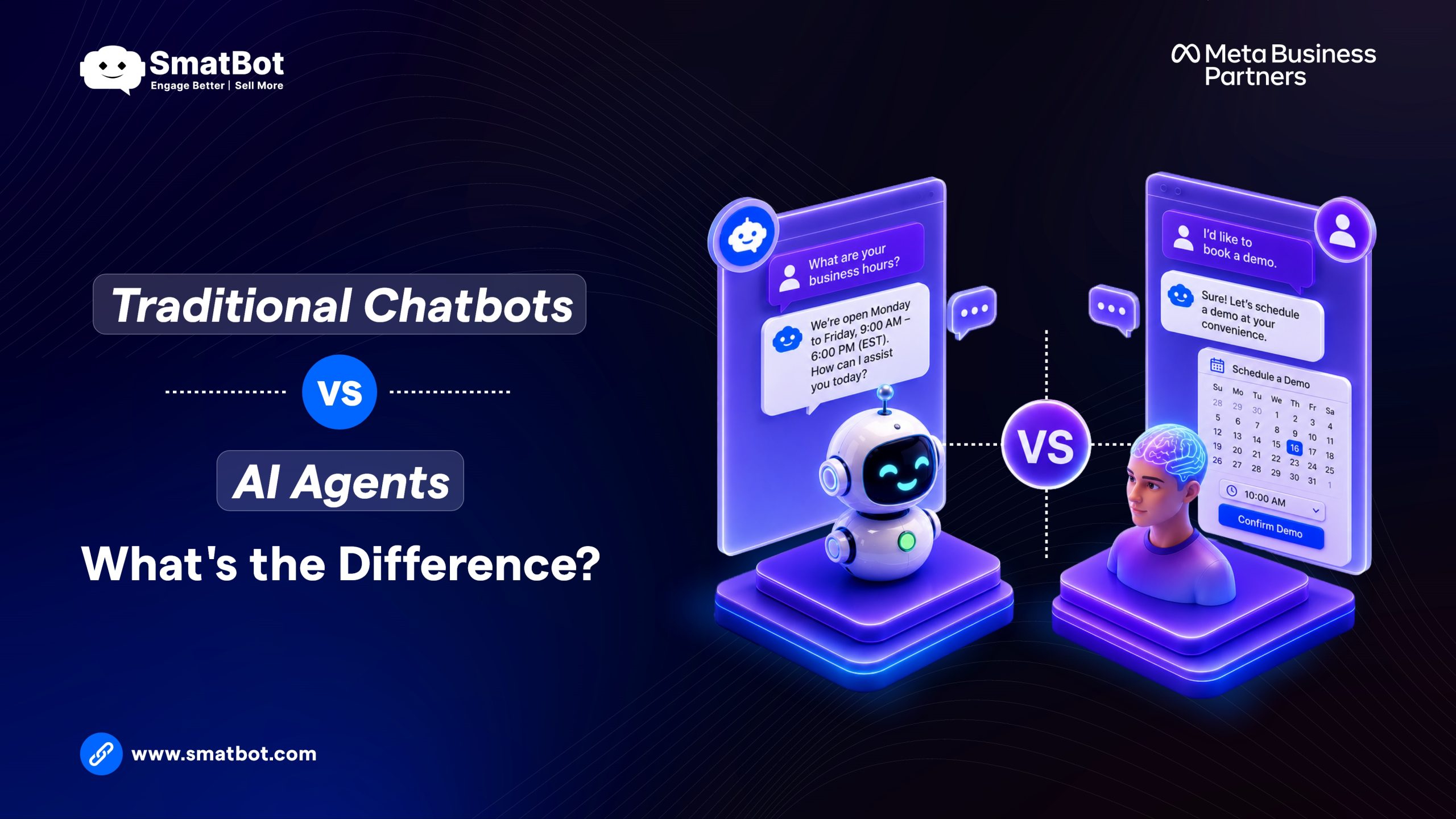
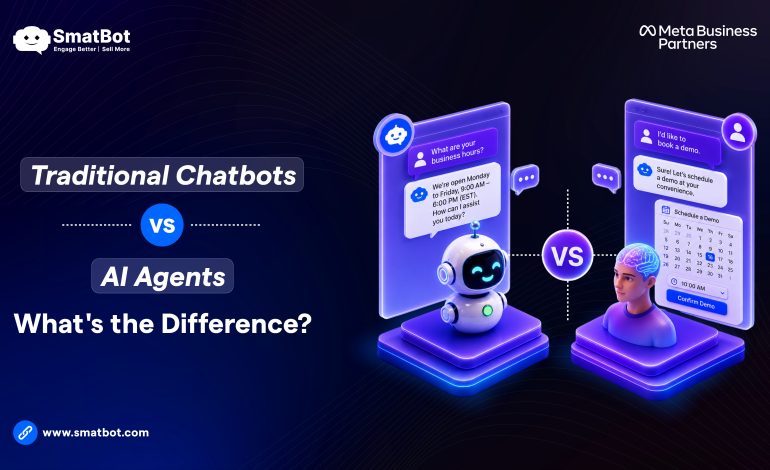
A traditional chatbot is a conversational tool that follows predefined rules or scripted conversation flows. It responds to user inputs based on keywords, decision trees, or programmed intents.
For example, if a customer asks:
“What are your business hours?”
The chatbot matches the query with an existing response and replies with the stored information.
Traditional chatbots are excellent for answering repetitive questions and handling structured conversations. However, they typically struggle when users ask unexpected questions or phrase requests differently from what they were trained to recognize.
What is an AI Agent?
An AI Agent goes far beyond simply answering questions.
Powered by Large Language Models (LLMs), reasoning capabilities, and integrations with business systems, AI agents can understand context, make decisions, perform multi-step tasks, and even use external tools to complete objectives. Rather than waiting for step-by-step instructions, they work toward accomplishing a defined goal.
Instead of merely replying to:
“I’d like to book a demo.”
An AI Agent can:
- Understand the customer’s intent
- Ask qualifying questions
- Check calendar availability
- Schedule the meeting
- Send a confirmation email or WhatsApp message
- Update the CRM
- Notify the sales representative
The conversation becomes outcome-driven instead of response-driven.
Traditional Chatbots vs AI Agents
| Feature | Traditional Chatbots | AI Agents |
| Conversation style | Script / Menu Driven | Natural and contextual |
| Understanding | Keyword/intent-based | Context-aware language understanding |
| Learning ability | Limited | Continuously improves through AI models and feedback |
| Decision making | Rule-based | Goal-oriented reasoning |
| Multi-step workflows | Limited | Yes |
| Personalization | Basic | Advanced |
| CRM & business integrations | Limited | Extensive |
| Human-like conversations | Moderate | High |
| Scalability | Good | Excellent |
Key Differences Explained
1. Intelligence
Traditional chatbots are built around predefined conversation flows. They work well when customers follow expected paths.
AI Agents understand intent rather than just keywords, allowing them to manage natural conversations even when users ask questions in different ways.
Example
Customer:
“I’m looking for something affordable for my business.”
Traditional chatbot:
“Please choose from Option 1, 2 or 3.”
AI Agent:
“I’d be happy to help. Could you tell me your business size and what you’re looking to automate?”
2. Context Awareness
One of the biggest limitations of traditional chatbots is memory.
If a customer asks multiple related questions, many chatbots treat each question independently.
AI Agents maintain conversational context throughout the interaction, creating a smoother and more natural experience.
3. Task Execution
Traditional chatbots primarily provide information.
AI Agents complete tasks.
For example, an AI Agent can:
- Book appointments
- Generate payment links
- Update CRM records
- Qualify leads
- Send follow-up messages
- Escalate conversations to human agents
- Trigger workflows across integrated applications
This shift from answering to acting is one of the defining characteristics of modern AI agents.
4. Personalization
Traditional chatbots usually deliver the same response to everyone.
AI Agents personalize conversations using available customer information such as:
- Previous conversations
- Purchase history
- Location
- Preferences
- CRM data
- Behavioral insights
This enables businesses to provide experiences that feel relevant and tailored.
5. Human Handover
Both solutions can transfer conversations to human agents.
The difference is that AI Agents know when to hand over and provide the human agent with conversation history and customer context, reducing repetition and improving resolution time.
When Should You Use a Traditional Chatbot?
Traditional chatbots remain a good option if your business needs to:
- Answer frequently asked questions
- Collect basic lead information
- Share business hours or contact details
- Route inquiries to the right department
- Operate within a limited budget
They’re simple, reliable, and effective for straightforward use cases.
When Should You Choose AI Agents?
AI Agents are better suited when you want to:
- Automate lead qualification
- Handle complex customer conversations
- Provide 24/7 customer support
- Schedule appointments
- Automate follow-ups
- Integrate with CRM and business tools
- Personalize customer experiences
- Support both chat and voice interactions
- Improve sales and operational efficiency
Organizations experiencing high inquiry volumes or scaling customer engagement often benefit most from AI agents.
Can Businesses Use Both?
Absolutely.
Many organizations adopt a hybrid approach.
Traditional automation handles simple and repetitive requests, while AI Chat & Voice Agents manage complex conversations, execute workflows, and collaborate with human teams when necessary.
This approach combines efficiency with personalized customer experiences.
The Future of Customer Conversations
Customer expectations continue to evolve.
People expect instant responses, personalized interactions, and seamless experiences across websites, messaging platforms, and phone calls.
As AI technology advances, businesses are increasingly moving from static chatbots toward intelligent AI Agents capable of understanding, reasoning, and completing tasks, not just answering questions. Industry analysts and technology providers increasingly describe AI as evolving from conversational assistants toward autonomous, goal-oriented systems.
Final Thoughts
Traditional chatbots laid the foundation for conversational automation, helping businesses respond faster and reduce repetitive work.
AI Agents represent the next evolution. Instead of simply responding to customer queries, they understand context, make informed decisions, automate business processes, and help teams focus on higher-value work.
The question is no longer “Should we automate customer conversations?”
It’s “How intelligent should our automation be?”
For businesses looking to improve customer engagement, accelerate response times, and streamline operations, AI Agents offer a future-ready approach that goes beyond conversation toward action.